Sepsis is the sharpest version of a general problem we are solving.
High-stakes treatments unfold over time, not at a single moment. Clinicians need systems that personalise the next treatment action as physiology changes — not another score telling them a patient is unwell. We proved the platform here first because sepsis is where that gap is widest.

A global emergency,
decided minute by minute
Sources: Global Burden of Disease,The Lancet 2020; Buchman et al., Critical Care Medicine 2020; University of York, 2017.
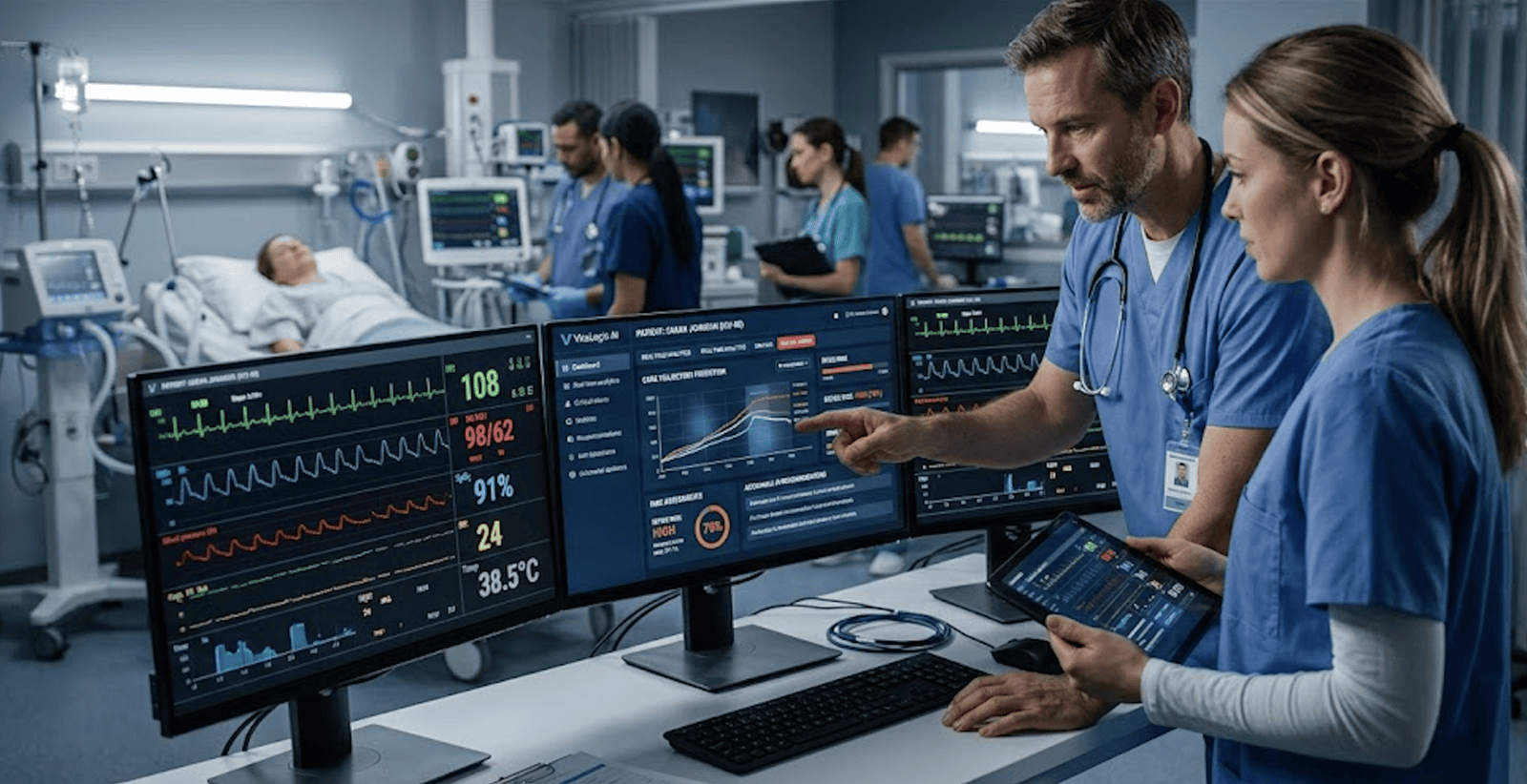
The gap is not more prediction — it is real-time action guidance
Resuscitation in sepsis is a sequence of repeated, time-critical choices — fluid volume, vasopressor dose, reassess — made under uncertainty as the patient’s physiology changes, sometimes within minutes. Heterogeneous physiology and incomplete information make each choice difficult, and variation between clinicians drives both harm and cost.
Today’s tools stop short of this. Risk scores and alerts tell a clinician that a patient is deteriorating, but rarely recommend a personalised next step — they add to cognitive load rather than reducing it. Guidelines set broad standards, but cannot optimise treatment for an individual patient in real time. What hospitals need is validated, workflow-integrated support for the treatment decision itself.
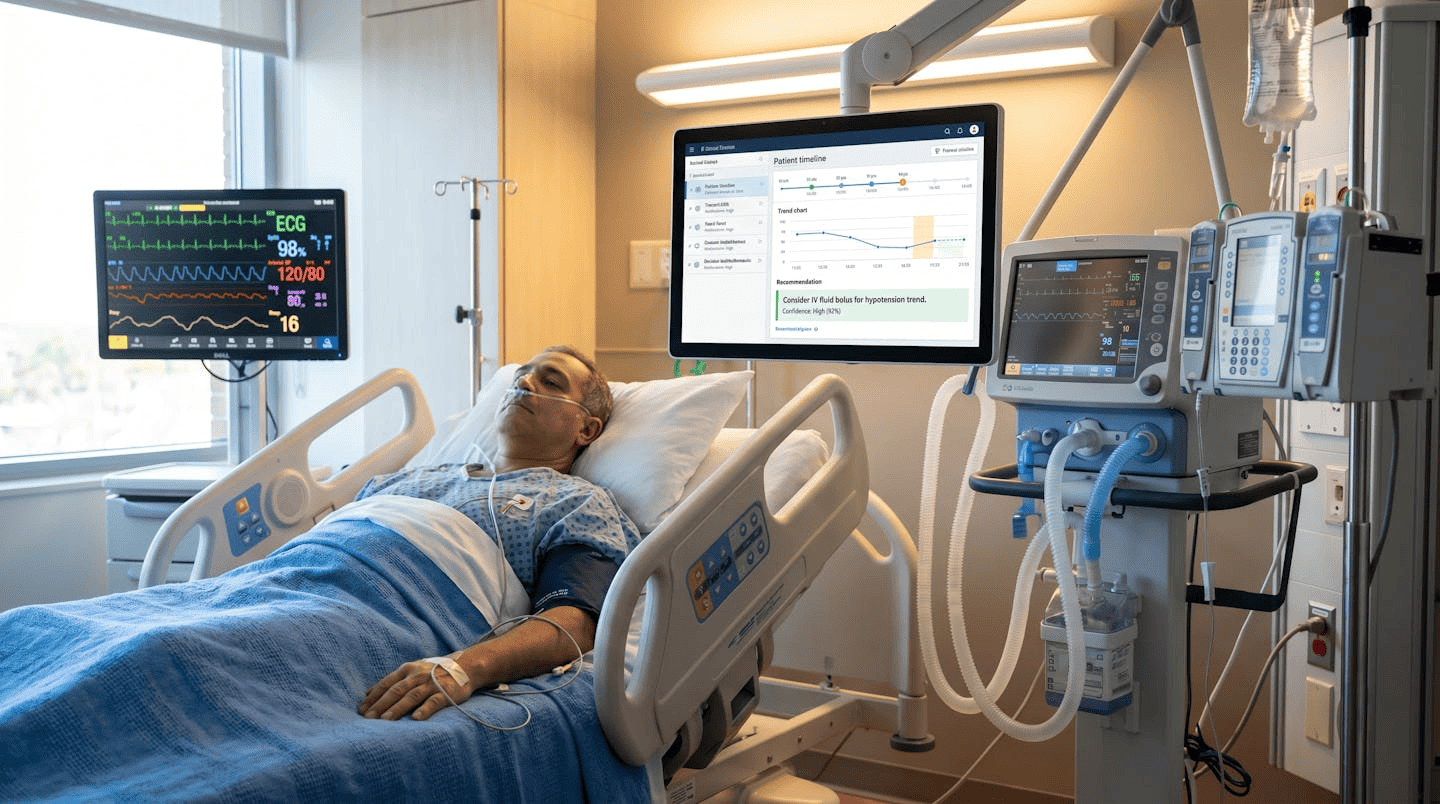
AI inside & with the existing clinical workflow
Minerva AI Clinician Sepsis works alongside the clinical team, not in place of it. It ingests routine ICU data — vitals, laboratory results, prior fluids and vasopressors — maintains a trajectory-aware picture of the patient’s state with calibrated uncertainty, and recommends the next fluid and noradrenaline-equivalent dose. The clinician reviews every recommendation and accepts, modifies or rejects it. This is advisory decision support, not closed-loop control: the treatment decision always belongs to the clinician.
Out of the archive, into live intensive care
In retrospective NHS data, mortality was around 3–4% lower where the clinician and the AI agreed on the treatment action. The model has since been evaluated prospectively in four NHS intensive care units, with recommendations delivered live inside the clinical workflow — on average within 36 seconds of new data, and as fast as two seconds — and human–AI agreement of 70–87% across key treatment actions.
Built for high-stakes deployment
The standard objection to reinforcement learning in medicine is safety. We have answered it with data. Predefined safety constraints refined the AI’s behaviour without degrading performance. In high-fidelity simulation, clinicians rejected 92% of deliberately unsafe AI recommendations — direct evidence that human oversight works. And the system’s influence on real fluid and vasopressor decisions has been quantified, independent of clinician seniority.